Who both labs pay
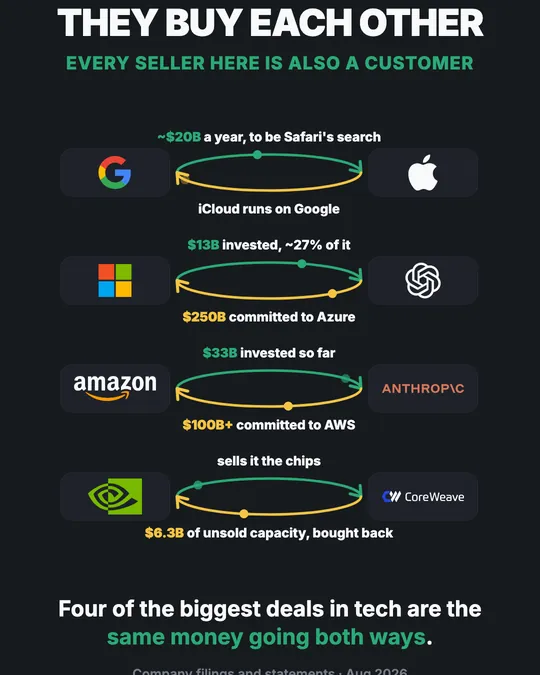
OpenAI and Anthropic are the two everyone compares. They buy cloud capacity from the same company, which invests in both.
One supplier line each, and the one drawn is the shared one. Every lab here buys from several - that is the whole shape of this market - so here are the full lists.
OpenAI has committed about $250bn of Azure, agreed in October 2025 when it completed its recapitalisation and Microsoft took a stake now worth roughly $135bn, about 27%. That Azure line is one of seven: the wider programme is reported at roughly $1.15 trillion, with Broadcom about $350bn, Oracle $300bn, Microsoft $250bn, Nvidia $100bn, AMD $90bn, Amazon $38bn and CoreWeave $22bn.
Anthropic committed $30bn of Azure in November 2025, and in the same announcement Microsoft agreed to invest up to $5bn and Nvidia up to $10bn. Azure is Anthropic's smallest big commitment, not its largest: it has roughly $100bn with AWS, whose Trainium chips run Project Rainier, and about $40bn of Google TPU capacity through 2030. In May 2026 it added a fifth supplier, and the most surprising one. SpaceX's IPO filing discloses cloud services agreements under which Anthropic pays $1.25bn a month through May 2029 - roughly $15bn a year - for capacity across Colossus and Colossus II, about 325,000 Nvidia GPUs. That is Anthropic renting compute from the company that builds Grok. Either side can walk on 90 days' notice, which is worth knowing before anyone calls it a $45bn commitment.
So the company selling compute to the leader is also funding the challenger.
Meta is on the chart with CoreWeave because that is its biggest outside supplier: $14.2bn signed in September 2025, expanded to $21bn in April 2026, about $35bn of commitments in total. It also pays Google Cloud a minimum of $10bn over six years. Meta builds enormous capacity of its own as well - the Hyperion campus in Louisiana and the gas plants being funded to power it - but it is not a company without landlords.
Google and xAI are the two that mainly run their own. Google's models train and serve on its own TPUs in its own data centres. xAI built Colossus in Memphis rather than renting it - and now rents it out. One more thing changed while nobody was looking: SpaceX acquired xAI in February 2026, so Colossus, Grok and X all sit inside the company that filed to go public in May.
What it means: in this cycle the supplier, the investor and the customer are often the same few companies in a different order. That is not evidence of anything improper - it is what happens when the only firms with capital and data centres are also the ones who need the models.